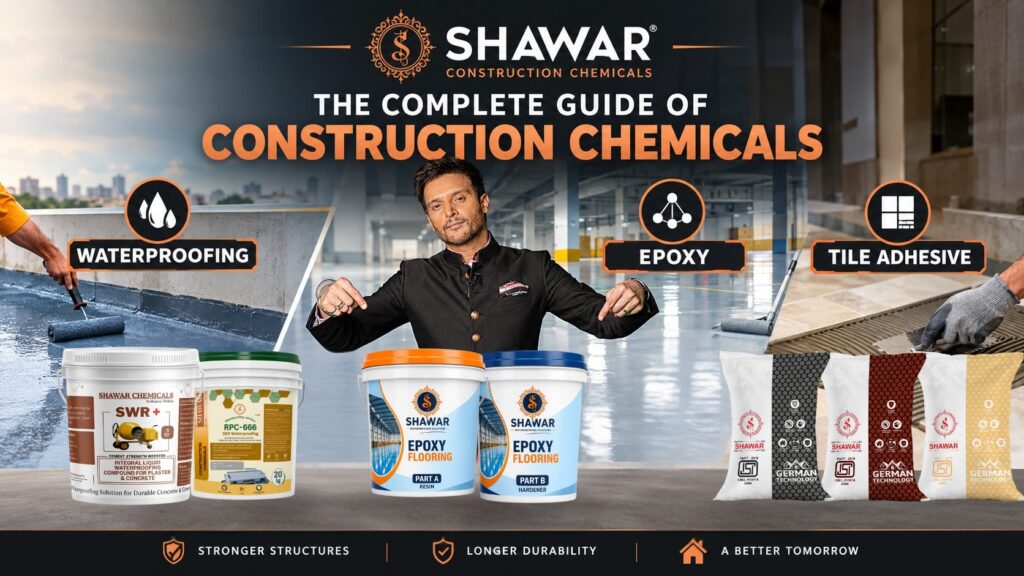
Construction chemicals are materials used to improve the performance, durability, and workability of buildings and infrastructure. They are used in residential, commercial, and industrial projects for applications such as tile installation, waterproofing, concrete protection, flooring, and structural repair.
As construction methods continue to evolve, these materials have become an important part of modern building practices. Selecting the right construction chemicals for a particular application can help improve bonding, reduce water penetration, protect surfaces, and extend the service life of a structure.
What Are Construction Chemicals?
Construction chemicals are specially formulated products added to or applied alongside conventional building materials such as cement, concrete, tiles, and masonry. They are designed to improve specific properties and address common construction challenges.
Depending on their composition and intended use, construction chemicals can provide the following benefits:
- Improved bonding between different building materials
- Better resistance to water and moisture
- Enhanced durability and flexibility
- Improved concrete workability
- Resistance to certain chemicals and environmental conditions
- Reduced maintenance requirements when properly applied
These products are commonly used in new construction, renovation, repair, and maintenance projects.
1. Tile Adhesive
Tile adhesive is a bonding material used to fix ceramic tiles, vitrified tiles, porcelain tiles, and certain types of natural stone to floors and walls. Cement-based tile adhesives often contain polymers and other additives that improve adhesion and workability.
Unlike traditional cement-sand mortar, a suitable tile adhesive is formulated for specific tile types and installation conditions. Choosing the correct grade is particularly important for large-format tiles, low-absorption tiles, and installations exposed to moisture or temperature changes.
Common applications of tile adhesive
- Fixing ceramic and vitrified floor tiles
- Installing wall tiles in kitchens and bathrooms
- Laying large-format porcelain tiles
- Fixing tiles over suitable prepared substrates
- Installing selected types of natural stone
The adhesive should be selected according to the tile material, tile size, substrate, location, and manufacturer’s recommendations. Proper surface preparation and application are equally important for achieving a reliable bond.
2. Waterproofing Chemicals
Water penetration can damage concrete, plaster, paint, and other building materials. Over time, moisture may contribute to damp patches, peeling finishes, corrosion of embedded steel, and deterioration of building components.
Waterproofing chemicals help limit water penetration when used as part of a suitable waterproofing system. The right solution depends on the source of moisture, the surface condition, and the amount of water exposure.
Types of waterproofing chemicals
Cementitious waterproofing: These coatings are commonly used in bathrooms, kitchens, water tanks, and other suitable cement-based surfaces.
Liquid waterproofing membranes: Applied in liquid form, these products create a continuous protective layer after curing. They are used on suitable roofs, terraces, balconies, and wet areas.
Bituminous waterproofing: Bitumen-based products are used in selected below-ground structures, foundations, and roofing applications.
Acrylic waterproofing coatings: These are commonly used on suitable exposed surfaces, particularly roofs and terraces, depending on the product specification.
Benefits of waterproofing
- Helps reduce water penetration
- Protects suitable surfaces against moisture damage
- Supports the durability of concrete and masonry
- Helps prevent deterioration of interior finishes
- Reduces the need for repeated repairs when correctly installed
Effective waterproofing requires more than applying a coating. Drainage, surface preparation, joint treatment, crack repair, and adequate curing all contribute to the performance of the system.
3. Epoxy Chemicals and Epoxy Flooring
Epoxy systems are widely used in flooring, tile grouting, protective coatings, and certain repair applications. A typical two-component epoxy system consists of a resin and a hardener that react to form a cured material.
Once properly cured, epoxy can provide a hard, durable surface with good adhesion and resistance to many chemicals. Its actual performance depends on the formulation, application method, and service conditions.
Common applications of epoxy
- Industrial and commercial flooring
- Epoxy tile grouting
- Protective coatings for selected surfaces
- Warehouses and manufacturing facilities
- Laboratories and other areas requiring specific chemical resistance
- Selected maintenance and repair applications
Advantages of epoxy flooring
Epoxy flooring can provide a seamless finish, making it easier to clean and maintain. Depending on the system, it can also offer abrasion resistance, chemical resistance, and the ability to withstand regular foot traffic or specified industrial loads.
However, the concrete substrate must be properly prepared before application. Moisture levels, surface strength, temperature, and curing conditions can all affect the final result.
4. Grouts and Construction Grouting Chemicals
Grout is used to fill spaces between tiles or within specific construction assemblies. The type of grout required depends on the joint width, exposure conditions, movement requirements, and intended application.
Construction grouting materials may also be used in selected repair, anchoring, and void-filling operations.
Common types of grout
Cement-based tile grout: Used to fill joints between tiles in many residential and commercial installations.
Epoxy grout: Made from epoxy resin and a hardener, it offers low water absorption and resistance to many stains and chemicals when correctly installed.
Non-shrink grout: Used for applications such as filling gaps beneath base plates and supporting machinery or structural components, depending on the specified grade.
Injection grout: Introduced into selected cracks, voids, or cavities to fill spaces or address particular repair requirements.
Why is grout important?
Grout contributes to the appearance and performance of tiled surfaces. The appropriate product can help protect tile joints against moisture, staining, and everyday wear. In other construction applications, grouting materials can fill voids and provide support where specified by the project design.
Grout should not be treated as a substitute for movement joints or a dedicated waterproofing system where either is required.
5. Concrete Admixtures
Concrete admixtures are materials added to concrete before or during mixing to modify its properties. They are used to improve workability, control setting time, reduce water requirements, and achieve specific performance targets.
The correct admixture depends on the concrete mix design, placement conditions, environmental temperature, and required strength.
Types of concrete admixtures
Plasticizers: Improve the workability of concrete or help reduce the amount of mixing water required for a specified consistency.
Superplasticizers: Provide greater water reduction or improved flow, depending on the formulation and mix design.
Accelerators: Help accelerate setting or early strength development in suitable applications.
Retarders: Slow the setting process when additional working time is required.
Water-reducing admixtures: Reduce mixing-water requirements while maintaining the desired workability.
Benefits of concrete admixtures
- Improved workability and placement
- Better control over setting characteristics
- Potential reduction in water-cement ratio
- Support for achieving the specified concrete strength
- Improved construction efficiency under suitable conditions
Admixtures should be selected and dosed according to technical specifications and compatibility with the other concrete ingredients. Incorrect dosage or unsuitable combinations can affect concrete performance.
6. Sealants and Protective Coatings
Sealants and protective coatings are used to protect joints and surfaces from moisture, weather exposure, movement, and other environmental conditions.
Sealants are commonly applied around windows, doors, construction joints, sanitary fittings, and selected façade details. Depending on the formulation, they may accommodate movement between adjoining materials.
Protective coatings serve different purposes, such as reducing water absorption, protecting certain surfaces against stains, or providing resistance to specific chemicals and weather conditions.
Examples include polyurethane sealants, acrylic coatings, and suitable stone sealers. The correct product must be compatible with the substrate and the conditions in which it will be used.
7. How to Choose the Right Construction Chemicals
Selecting a construction chemical requires an understanding of the application rather than relying on a product name alone. Two products within the same category may have different performance characteristics and intended uses.
Consider the following factors before making a selection:
- Application area: Determine whether the product will be used on a floor, wall, roof, bathroom, industrial surface, or structural component.
- Substrate condition: Check the surface material, strength, cleanliness, moisture condition, and existing coatings.
- Exposure conditions: Consider water, sunlight, temperature changes, chemicals, traffic, and mechanical loads.
- Product specifications: Review the technical data sheet for coverage, mixing ratio, application thickness, pot life, and curing requirements.
- Compatibility: Confirm that the product is suitable for the other materials used in the installation.
- Installation requirements: Follow the recommended surface preparation, application procedure, and curing period.
For specialised structural repairs or demanding industrial applications, the product selection should also follow the project specification and relevant professional guidance.
8. Common Mistakes to Avoid When Using Construction Chemicals
Even a suitable product may perform poorly if it is applied incorrectly. Many problems can be avoided by following the manufacturer’s instructions and using the product for its intended purpose.
Common mistakes include:
- Applying chemicals over dusty, weak, or contaminated surfaces
- Using an unsuitable adhesive for the tile type or installation location
- Applying waterproofing without properly treating cracks and joints
- Mixing two-component products in incorrect proportions
- Adding excess water to cement-based products
- Ignoring recommended application thickness and curing time
- Applying coatings under unsuitable temperature or moisture conditions
- Using grout in place of movement joints
Reading the technical data sheet before starting work helps establish the correct procedure and reduces the risk of avoidable application problems.
Conclusion
Construction chemicals play an important role in tile installation, waterproofing, concrete performance, flooring, grouting, and surface protection. Each category serves a different purpose, and the best results come from matching the product to the application and substrate.
Tile adhesives support tile bonding, waterproofing systems help control moisture penetration, epoxy materials provide durable finishes for suitable applications, grouts fill joints and specified voids, and concrete admixtures modify the properties of fresh or hardened concrete.
Understanding these materials, following technical specifications, and applying them correctly can help improve construction quality, reduce maintenance needs, and support the long-term performance of buildings.
Frequently Asked Questions
Q1. What are construction chemicals?
Construction chemicals are specialised products used to improve the bonding, durability, workability, waterproofing, or protection of building materials.
Q2. What are the main types of construction chemicals?
Common types include tile adhesives, waterproofing chemicals, epoxy systems, grouts, concrete admixtures, sealants, and protective coatings.
Q3. Why are construction chemicals used in buildings?
They help improve material performance, address moisture problems, support reliable installation, and reduce certain maintenance requirements.
Q4. Which tile adhesive is best for vitrified tiles?
A polymer-modified adhesive of the appropriate grade for vitrified tiles and the intended substrate is generally suitable.
Q5. What are waterproofing chemicals used for?
They help protect suitable surfaces, such as roofs, terraces, bathrooms, and basements, against water penetration.
Q6. What is the difference between epoxy grout and cement grout?
Epoxy grout generally offers lower water absorption and better resistance to many stains and chemicals than conventional cement-based grout.
Q7. Where is epoxy flooring commonly used?
Epoxy flooring is used in warehouses, factories, commercial spaces, laboratories, and other areas requiring a suitable durable coating.
Q8. What is the purpose of concrete admixtures?
Concrete admixtures modify properties such as workability, setting time, and water requirements to meet specific construction needs.
Q9. How much area does a 20 kg bag of tile adhesive cover?
Coverage varies with tile size, trowel notch, substrate flatness, and application thickness; the manufacturer’s stated coverage should be followed.
Q10. Can waterproofing chemicals prevent dampness permanently?
They can help control water penetration when the moisture source is correctly identified and the appropriate system is properly installed.
Q11. How should construction chemicals be stored?
Store them in their original, sealed packaging under the temperature and storage conditions specified by the manufacturer.
Q12. Why is surface preparation important before applying construction chemicals?
Proper preparation helps ensure adhesion, consistent application, and the intended performance of the product.