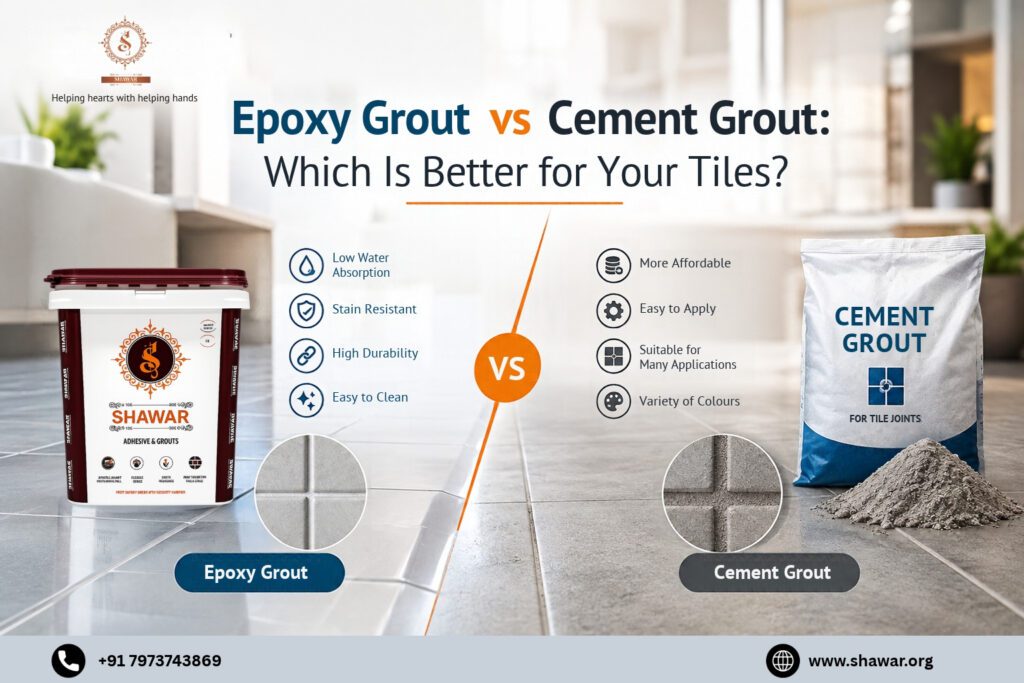
When choosing tiles for a home or commercial space, most people focus on the tile design, colour, size and finish. Grout is often considered a minor detail, but it plays an important role in the overall appearance and durability of a tiled surface. The right grout helps fill the joints between tiles, keeps the finish neat and makes regular maintenance easier. Two common options are epoxy grout vs cement grout. Although both are used to fill tile joints, they differ in composition, water resistance, durability, maintenance and application.
Understanding epoxy grout and cement grout can help you make a better decision for your bathroom, kitchen, living room, balcony or commercial flooring project.
What Is Tile Grout?
Tile grout is a material used to fill the gaps between tiles after they have been installed. These joints allow for small variations in tile dimensions and help create a uniform finish.
Grout also prevents dirt from collecting easily in open joints and contributes to the overall performance of the tiled surface. However, grout is not a substitute for a proper waterproofing system, particularly in bathrooms, balconies and other areas exposed to regular moisture.
The two commonly used options are cement-based grout and epoxy grout. Each has its own characteristics and is suitable for different requirements.
What Is Cement Grout?
Cement grout is generally made from cement, fine fillers, pigments and other additives. Depending on the formulation, it is mixed with water or a specified liquid before application.
It is widely used in residential and commercial tiling because it is familiar to installers and is generally economical.
Advantages of Cement Grout
1. Affordable option
Cement grout usually has a lower initial material cost than epoxy grout. It can be a practical choice for large tiling projects where the budget is an important consideration.
2. Easy to apply
Many tile installers are experienced in working with cement grout. Its application process is relatively straightforward when the manufacturer’s mixing and installation instructions are followed.
3. Suitable for many applications
Cement grout is commonly used in living rooms, bedrooms, walls and other tiled areas where the expected moisture exposure and maintenance requirements are manageable.
4. Available in different colours
Cement grout comes in a variety of shades, making it easier to coordinate the joints with the colour and design of the tiles.
Disadvantages of Cement Grout
Cement grout is generally more porous than epoxy grout. As a result, it can absorb moisture and stains, depending on its formulation, installation quality and whether an appropriate sealer is used.
Over time, cement grout may become discoloured, especially in kitchens, bathrooms and frequently used areas. It may also require more regular cleaning and maintenance.
Cracking can occur if the grout is mixed incorrectly, installed under unsuitable conditions or exposed to excessive movement. Proper joint design and installation remain important regardless of the grout selected.
What Is Epoxy Grout?
Epoxy grout is made using epoxy resin, a hardener and specially selected fillers. The components react when mixed to form a hard, durable material.
It is often selected for areas where resistance to stains, moisture and cleaning chemicals is important. However, the exact performance depends on the product formulation and the conditions in which it is installed.
Advantages of Epoxy Grout
1. Excellent resistance to stains
One of the main benefits of epoxy grout is its resistance to many common stains. This makes it useful in kitchens, bathrooms and commercial spaces where spills and regular cleaning are expected.
2. Low water absorption
Epoxy grout generally absorbs much less water than conventional cement grout. This makes it a suitable option for many moisture-prone areas when the product is approved for the intended application.
3. Durable finish
When mixed and applied correctly, epoxy grout forms a hard, durable joint that can withstand regular use. It is frequently considered for areas with demanding cleaning and maintenance requirements.
4. Easier routine cleaning
Because epoxy grout is less porous, dirt and many stains are less likely to penetrate the joint. This can make routine maintenance easier compared with untreated cement grout.
5. Consistent appearance
Epoxy grout can help maintain the appearance of tile joints over time because it is generally more resistant to staining and discolouration.
Disadvantages of Epoxy Grout
Epoxy grout typically costs more than cement grout, both in material price and, in some cases, installation labour.
Its application also requires greater care. The resin and hardener must be mixed according to the manufacturer’s instructions, and excess material must be cleaned from the tile surface within the specified working time. Once cured, removing epoxy residue can be difficult.
Some formulations can be challenging for inexperienced installers. For this reason, using a suitable product and following the recommended installation procedure are important.
Epoxy Grout vs Cement Grout: Key Differences
The main difference between epoxy grout and cement grout is how they perform under moisture, staining, cleaning and everyday use.
| Feature | Epoxy Grout | Cement Grout |
|---|---|---|
| Composition | Epoxy resin, hardener and fillers | Cement, fillers and additives |
| Water absorption | Generally very low | Generally higher |
| Stain resistance | Usually excellent | Varies by formulation and sealing |
| Durability | High when correctly installed | Depends on formulation and installation |
| Maintenance | Usually easier to keep clean | May need more frequent cleaning |
| Initial cost | Generally higher | Generally lower |
| Application | Requires careful handling and cleaning | Usually simpler to apply |
| Best suited for | Areas needing high stain and moisture resistance | General tiling and budget-conscious projects |
The right choice depends on the location, expected exposure, maintenance routine and installation budget.
Which Is Better for Bathroom Tiles?
Bathrooms are regularly exposed to water, soap residue and cleaning products. For these conditions, epoxy grout is often a suitable choice because of its low water absorption and resistance to many stains.
It can be particularly useful around shower areas and bathroom floors when the selected product is suitable for those applications.
However, epoxy grout for bathroom tiles does not eliminate the need for proper waterproofing beneath the tiles. Water can enter through other weak points, such as corners, pipe penetrations, movement joints and poorly sealed connections.
Cement grout can also be used in bathrooms when the product is suitable for the conditions and installed correctly. Appropriate sealing, where recommended, and regular maintenance can help improve its performance.
Which Grout Is Better for Kitchen Floors and Walls?
Kitchen tiles are exposed to cooking oil, food spills, grease and frequent cleaning. These conditions make grout selection an important part of maintaining a clean and durable tiled surface.
When comparing epoxy grout vs cement grout, epoxy grout is often preferred for kitchen backsplashes and floors because it offers good resistance to common stains and has low water absorption. Its smooth, less porous surface also makes routine cleaning easier, helping keep tile joints looking clean for longer.
Cement grout is a more economical option for kitchen installations, particularly when the budget is limited. However, it may require more maintenance and appropriate sealing, depending on the product formulation and manufacturer’s recommendations.
In both cases, choose a grout that is compatible with the tile type, joint width and expected use of the surface.
Is Epoxy Grout Worth the Extra Cost?
Whether epoxy grout is worth the additional cost depends on the project.
For areas exposed to frequent spills, moisture, staining or demanding cleaning routines, epoxy grout may provide better long-term value. Its resistance to many stains and low water absorption can reduce some maintenance problems.
For dry residential areas, bedrooms and other spaces with lower exposure to stains and moisture, cement grout may be sufficient and more economical.
When comparing costs, consider more than the price of the material. Installation labour, cleaning requirements, expected maintenance and the consequences of premature grout failure should also be considered.
How to Choose the Best Grout for Floor Tiles
Choose the best epoxy grout vs cement grout for floor tiles, consider these practical factors:
- Location: Bathrooms, kitchens, balconies and commercial areas may have different moisture and cleaning requirements.
- Tile type: Check whether the grout is suitable for ceramic, porcelain, vitrified or natural stone tiles.
- Joint width: Select a product designed for the width of the tile joints.
- Maintenance: Consider how frequently the area will be cleaned and whether stain resistance is important.
- Budget: Compare the initial material and installation costs with the expected maintenance requirements.
- Installation conditions: Follow the manufacturer’s instructions for mixing, application, cleaning and curing.
Natural stone may require special care because some grout formulations or cleaning methods can affect sensitive surfaces. Always check product compatibility before starting the work.
Common Mistakes to Avoid During Grouting
Even a good grout product may not perform as expected if it is installed incorrectly. When comparing epoxy grout vs cement grout, proper preparation and application are important for achieving a durable, clean finish.
First, avoid mixing cement grout or epoxy grout with arbitrary quantities of water, resin or hardener. Always follow the manufacturer’s recommended mixing ratios and instructions.
Second, make sure the tile joints are clean and ready for grouting. Dust, adhesive residue and other contaminants can affect the final finish and performance.
Third, do not delay cleaning epoxy grout beyond the product’s recommended working time. Hardened residue can be difficult to remove without the correct cleaning method.
Finally, do not treat grout as a complete waterproofing solution. Wet areas require an appropriately designed waterproofing system, properly treated junctions and suitable installation practices.
Final Thoughts
When comparing epoxy grout vs cement grout, neither option is automatically the best for every project.
Epoxy grout is generally a strong choice where stain resistance, low water absorption and easy maintenance are priorities. Cement grout is often a practical and economical option for general tiling, particularly in areas with lower exposure to moisture and stains.
The best grout for your tiles depends on the application, tile material, joint width, budget and expected maintenance. Selecting a compatible product and ensuring correct installation are just as important as choosing between the two grout types.
At Shawar Chemicals, understanding the requirements of each tiling project is an important starting point when evaluating construction chemical solutions. Comparing epoxy grout vs cement grout can help you choose the right option based on durability, water resistance, maintenance and application needs. Before selecting a grout, review the product’s technical specifications and application guidelines to ensure it is suitable for the intended surface and conditions.
FAQs: Epoxy Grout vs Cement Grout
1. What is the main difference between epoxy grout vs cement grout?
Epoxy grout offers better stain resistance and lower water absorption, while cement grout is generally more affordable and easier to apply.
2. Is epoxy grout better than cement grout for bathroom tiles?
Epoxy grout is often preferred for bathrooms because of its moisture and stain resistance.
3. Which grout is best for floor tiles?
The best grout depends on the tile type, joint width, moisture exposure, foot traffic and maintenance requirements.
4. Is epoxy grout waterproof?
Epoxy grout has very low water absorption, but it does not replace a proper waterproofing system.
5. How long does epoxy grout last?
Epoxy grout can last for many years when properly selected, installed and maintained.
6. What are the disadvantages of epoxy grout?
Its main disadvantages are higher cost, more demanding application and difficult removal of hardened residue.
7. Does cement grout need sealing?
Some cement grouts benefit from sealing, depending on the product formulation and manufacturer’s recommendations.
8. Is epoxy grout more expensive than cement grout?
Yes, epoxy grout generally has a higher initial material and installation cost.
9. Can epoxy grout be used for kitchen tiles?
Yes, it is often suitable for kitchen floors and backsplashes because of its stain resistance.
10. How do I choose between epoxy grout vs cement grout?
Consider your budget, tile type, installation conditions, moisture exposure and expected maintenance before choosing.