
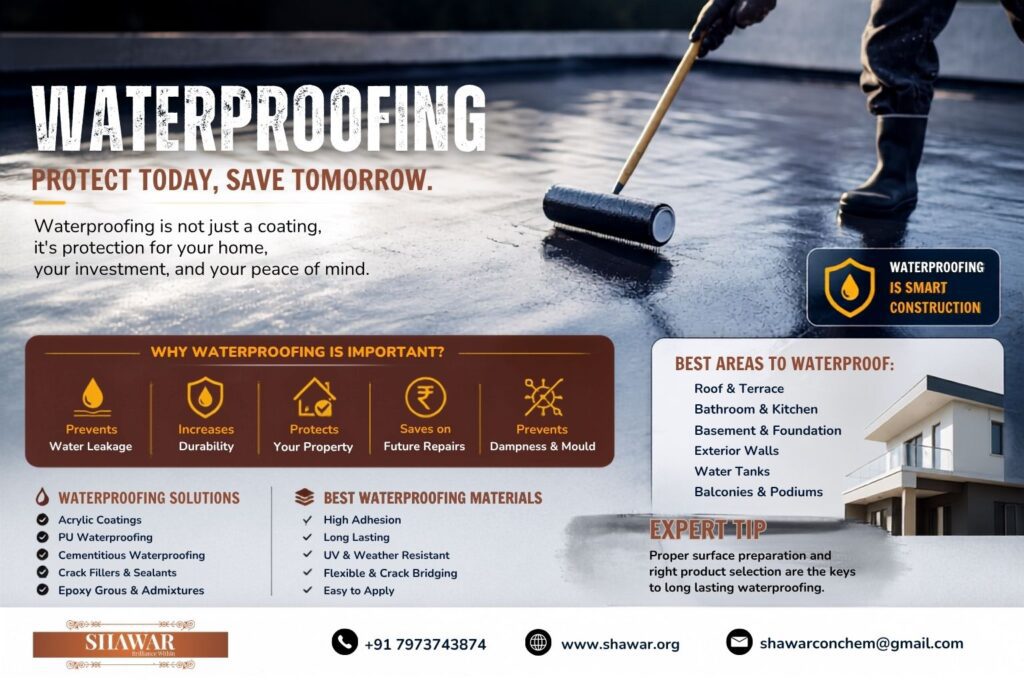
Water is one of the biggest enemies of any building. A small leakage on a terrace, dampness on a wall, or moisture in a bathroom may look like a minor issue in the beginning. But if it is ignored, the problem can gradually affect plaster, paint, tiles, concrete, and the overall condition of the structure.
This is where waterproofing Solutions becomes important.
Whether you are constructing a new house, renovating an old property, or dealing with roof leakage during the monsoon, choosing the right waterproofing solutions and best waterproofing materials can make a significant difference.
At Shawar Conchem, we believe waterproofing is not simply about applying a chemical to a surface. It is about understanding the source of moisture, selecting the right system, preparing the surface properly, and applying the material correctly.
In this guide, let’s understand waterproofing in simple terms and explore how to choose the right solution for your project.
What Is Waterproofing?
Waterproofing solutions is the process of protecting a building or surface from unwanted water penetration and moisture.
It can be used on different areas such as:
- Roofs and terraces
- Bathrooms and kitchens
- External walls
- Basements
- Water tanks
- Balconies
- Concrete structures
- Tile joints and wet areas
Depending on the surface and the type of water exposure, different waterproofing systems may be required.
That’s why there is no single product that can be called the best waterproofing material for every application.
The right material depends on the right application.
Why Is Waterproofing Important?
Think about a terrace during the monsoon.
Rainwater continuously stays on the surface. If there are cracks, weak joints, damaged coatings, or poor drainage, water can slowly find its way into the concrete.
Initially, you may notice:
- Damp patches
- Paint peeling
- Water stains
- Cracks
- Mold or fungus
- Moisture on ceilings
- Bad odour in closed areas
If the source is not treated properly, these problems can become more difficult and expensive to repair.
Good waterproofing helps protect surfaces from water penetration while improving the durability and service life of the treated area.
What Are the Different Waterproofing Solutions?
Different areas of a building have different requirements. Here are some commonly used waterproofing solutions.
1. Roof & Terrace Waterproofing
Terraces are constantly exposed to sunlight, rain, temperature changes, and standing water.
Depending on the condition of the surface, solutions may include:
- Acrylic waterproof coatings
- PU-based waterproofing systems
- Cementitious waterproofing
- Repair and crack-treatment systems
Before selecting a product, the existing surface should be inspected carefully.
2. Bathroom Waterproofing
Bathrooms are continuously exposed to water.
Water can enter through:
- Floor joints
- Wall-floor junctions
- Pipe penetrations
- Cracks
- Tile joints
- Improperly treated corners
Waterproofing should ideally be completed before tiling so that the underlying surface gets proper protection.
A suitable cementitious or other compatible waterproofing system can be selected depending on the project requirements.
3. Wall Waterproofing
External walls can develop dampness because of rainwater, cracks, damaged exterior coatings, or water entering through vulnerable areas.
For external walls, suitable waterproof coatings can help reduce water penetration while allowing the surface to maintain appropriate breathability.
However, simply painting over a damp wall is usually not enough.
First identify the moisture source. Then treat it.
4. Basement Waterproofing
Basements require special attention because they may be exposed to ground moisture and water pressure.
Depending on the construction and site conditions, basement waterproofing may involve:
- Cementitious systems
- Crystalline waterproofing
- Membrane systems
- Joint treatment
- Crack injection or repair systems
- Proper drainage arrangements
For serious basement leakage, professional inspection is recommended rather than relying on a simple surface coating.
How Do You Choose the Best Waterproofing Materials?
With so many products available in the market, choosing the best waterproofing materials can be confusing.
Instead of selecting a product only because it is popular or inexpensive, consider these factors.
1. Understand the Surface
Is it a terrace, bathroom, basement, wall, water tank, or concrete structure?
The application determines the type of waterproofing system required.
2. Identify the Source of Water
Is water coming from:
- Surface cracks?
- Construction joints?
- Pipe penetrations?
- Poor drainage?
- External walls?
- Groundwater?
Finding the actual source is one of the most important parts of waterproofing.
3. Check Surface Condition
Dust, loose concrete, oil, old coatings, algae, and weak surfaces can affect adhesion.
Proper surface preparation should never be ignored.
4. Consider Water Exposure
A surface exposed to occasional rainwater may require a different solution from a basement exposed to continuous moisture or water pressure.
5. Follow the Application Guidelines
Even a high-quality waterproofing material may not perform as expected if it is mixed, applied, cured, or layered incorrectly.
Product quality and application quality work together.
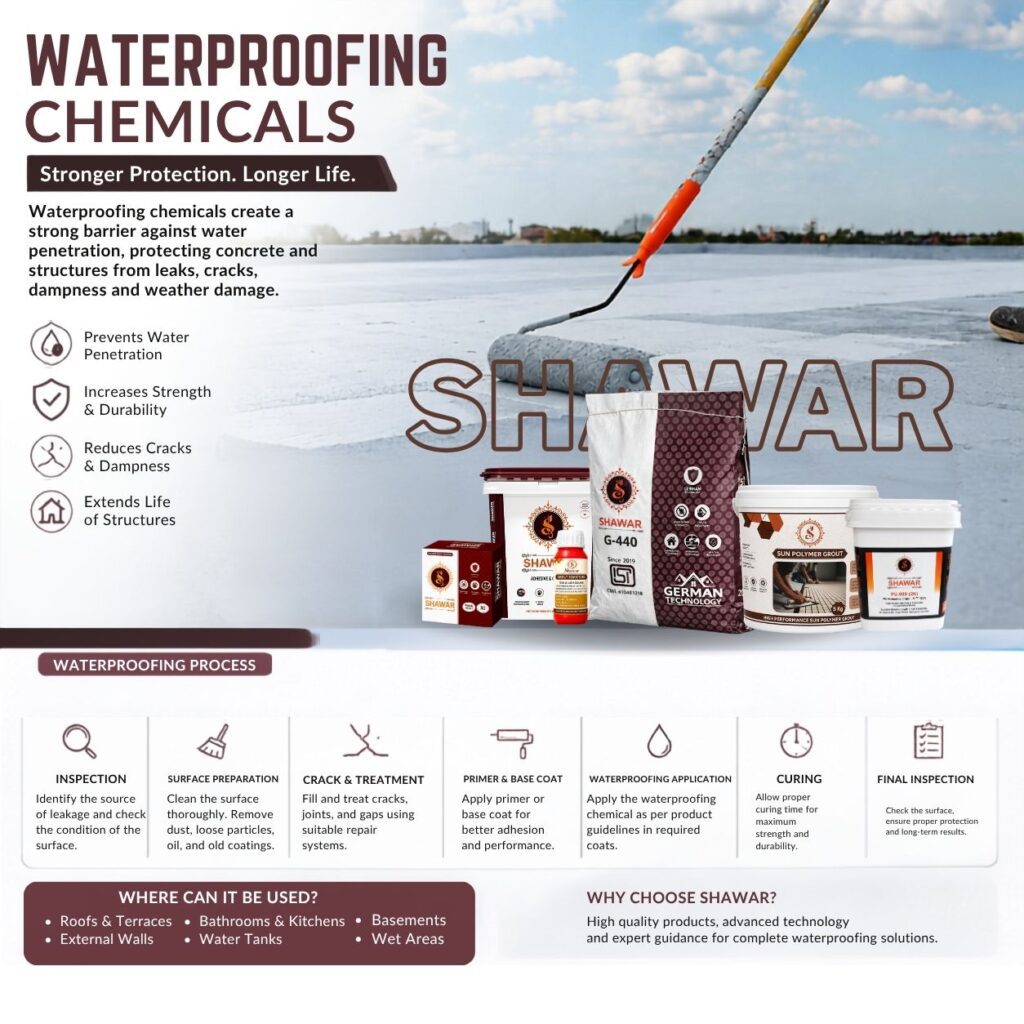
Waterproofing: Product Alone Isn’t the Whole Solution
This is one of the most important things homeowners and contractors should understand.
People often ask:
“Which waterproofing chemical is the best?”
But the better question is:
“Which waterproofing system is suitable for my surface and problem?”
A good waterproofing system generally involves:
Inspection → Surface Preparation → Crack/Joint Treatment → Primer or Base Treatment → Waterproofing Application → Curing → Final Inspection
Skipping any important step can affect the overall performance of the system.
Common Waterproofing Mistakes to Avoid
❌ Applying a coating over a dirty surface
Dust, dirt, algae, and loose material can reduce adhesion.
❌ Ignoring cracks
If cracks are responsible for water entry, simply applying a coating over them may not solve the underlying issue.
❌ Choosing the cheapest product
Price should not be the only factor when selecting waterproofing materials.
❌ Applying the wrong product
A product suitable for a bathroom may not necessarily be suitable for a terrace or basement.
❌ Ignoring drainage
If water continuously accumulates on a terrace, waterproofing alone may not solve the complete problem. Proper slope and drainage are also important.
❌ Not following curing requirements
Waterproofing systems often require specific drying or curing periods. Follow the manufacturer’s technical instructions carefully.
Can Waterproofing Be Done in an Old Building?
Yes. Waterproofing can be carried out in both new and existing buildings, but the approach may be different. For an old building, the first step should be identifying where the moisture is coming from.
For example, if a ceiling has a damp patch, the visible damage may not be the actual source of the leakage.
The water could be entering from:
- A terrace above
- A bathroom
- A pipe joint
- An external wall
- A crack
- A poorly sealed construction joint
Treating only the visible damp patch may provide a temporary improvement without solving the actual problem.
When Should Waterproofing Be Done?
The best time to waterproof a building is before water-related problems become serious. For new construction, waterproofing should be incorporated into the construction process at the appropriate stages.
- Bathrooms before tiling
- Basements during construction
- Roofs and terraces
- Water tanks
- Balconies
- Wet areas
- Critical joints and penetrations
For existing buildings, regular inspection before the monsoon can help identify cracks, damaged coatings, blocked drainage, and other vulnerable areas.
How Long Does Waterproofing Last?
There is no single lifespan that applies to every waterproofing system.
The durability of waterproofing depends on several factors:
- Quality of the material
- Surface preparation
- Application quality
- Weather exposure
- Water pressure
- Movement or cracking of the structure
- Maintenance
- Correct product selection
A properly designed and correctly applied system can provide long-term protection, but the expected service life should always be discussed based on the specific product and application.
Never choose a waterproofing product solely on a promised number of years.
How Much Does Waterproofing Cost?
Waterproofing cost varies from project to project.
The final price may depend on:
- Area size
- Surface condition
- Type of waterproofing system
- Material requirements
- Crack and joint repairs
- Labour
- Number of coats
- Accessibility of the site
- Required surface preparation
For this reason, a professional assessment is usually more useful than relying on a fixed per-square-foot price found online.
A cheaper quotation is not always the most economical option if the work needs to be repeated soon.
How to Find the Best Waterproofing Company?
When searching for the best waterproofing company, don’t look at the product name alone.
Look for a company that can provide:
✅ Suitable products for different applications
✅ Clear technical information
✅ Consistent product quality
✅ Application guidance
✅ Proper surface-preparation recommendations
✅ Reliable customer support
✅ Transparent product information
✅ Solutions suitable for residential, commercial, and industrial requirements
A good waterproofing company should help you understand why a particular solution is recommended, not simply sell you a product.
Choosing a Reliable Waterproofing Manufacturer
The quality of the manufacturer matters because waterproofing performance depends heavily on consistency and product formulation.
When evaluating a waterproofing manufacturing company, consider:
- Manufacturing standards
- Product testing
- Quality-control practices
- Technical documentation
- Application instructions
- Product range
- Industry experience
- Customer support
At Shawar Conchem, our focus is on developing construction chemical solutions around real project requirements.
Our product range includes solutions related to waterproofing, epoxy, grouting, tile adhesives, and other construction chemical applications.
Why Choose Shawar Conchem?
At Shawar Conchem, we understand that construction professionals need more than just a chemical product.
They need consistency, technical understanding, practical solutions, and dependable support.
Our approach focuses on:
Quality
Products developed with attention to performance and consistency.
Innovation
Continuous improvement based on changing construction requirements.
Practical Solutions
Products designed with real application conditions in mind.
Transparency
Clear product information helps customers make informed decisions.
Customer Support
We work with builders, contractors, architects, dealers, applicators, and other construction professionals to understand their requirements.
Our objective is simple:
To provide construction chemical solutions that help professionals build with greater confidence.
Final Thoughts: The Right Waterproofing Solution Starts With the Right Diagnosis
Waterproofing is not simply about putting a coating over a surface.
It starts with understanding the problem.
A terrace leakage, bathroom seepage, damp wall, and basement moisture problem can have completely different causes—and therefore may require completely different waterproofing solutions.
So before buying what claims to be the best waterproofing material, ask three simple questions:
Where is the water coming from?
What is causing the problem?
Which waterproofing system is actually suitable for the surface?
Once these questions are answered, choosing the right material becomes much easier.
At Shawar Conchem, we believe better construction begins with better solutions, better information, and the right approach to every project.
Shawar Conchem — Building Trust. Strengthening Structures.
For waterproofing and construction chemical requirements, connect with our team for product and application guidance.