
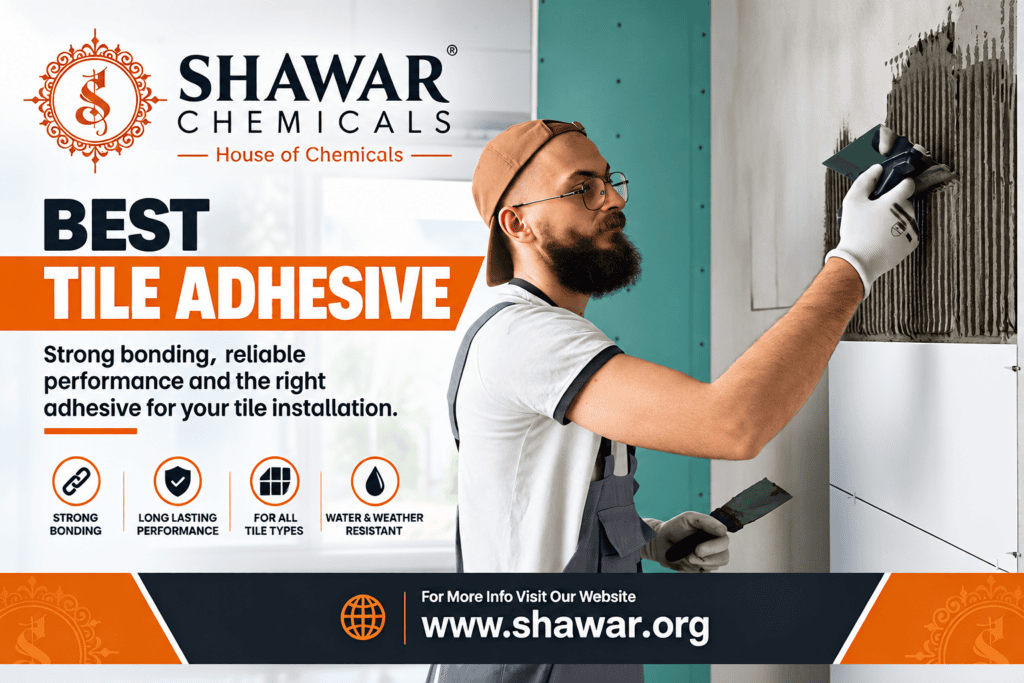
Choosing the best tile adhesive is one of the most important decisions when installing tiles. Whether you are constructing a new home, renovating a bathroom, installing vitrified tiles, or working on a commercial project, the right tile adhesive plays a major role in achieving a strong, durable, and professional finish.
Many people invest heavily in premium-quality tiles but pay less attention to the adhesive used for installation. The wrong adhesive can result in loose tiles, hollow sounds, tile lifting, cracks, and expensive repairs.
So, how do you choose the best tile adhesive?
This complete guide explains the important factors you should consider before purchasing and using tile adhesive.
What Is Tile Adhesive?
Tile adhesive is a specially formulated cement-based or polymer-modified construction material used to bond tiles securely to different substrates.
Compared with traditional cement-sand mortar, modern tile adhesives are designed to provide improved bonding, workability, flexibility, and installation performance.
Depending on the formulation, tile adhesive can be used for:
- Ceramic tiles
- Vitrified tiles
- Porcelain tiles
- Marble
- Granite
- Natural stone
- Large-format tiles
- Wall tiles
- Floor tiles
The correct adhesive should always be selected according to the tile, substrate, location, and manufacturer’s recommendations.
Why Is Choosing the Best Tile Adhesive Important?
The adhesive is the layer that connects the tile to the surface. Therefore, its performance directly affects the durability of the tile installation.
1. Strong Bonding
A good-quality tile adhesive provides reliable adhesion between the tile and substrate. Strong bonding helps reduce the possibility of tiles becoming loose or detached during service.
2. Better Durability
The right adhesive should be suitable for the environmental and loading conditions of the installation. Depending on the product, it may provide resistance to moisture, temperature variations, and everyday loads.
3. Improved Flexibility
Some polymer-modified tile adhesives provide greater flexibility than traditional mortar. This can help accommodate minor movements between the tile and substrate.
4. Suitable for Wet Areas
Bathrooms, kitchens, balconies, and other moisture-prone areas require an adhesive appropriate for wet conditions. Always select a product specifically recommended for the intended application.
5. Easier Installation
A quality tile adhesive should offer good workability, allowing installers to mix, spread, and adjust the material efficiently when used according to the manufacturer’s instructions.
How to Choose the Best Tile Adhesive?
There is no single adhesive that is automatically the best for every tile and every application. The right product depends on several factors.
1. Identify Your Tile Type
The first step is to identify the type of tile you are installing.
Different tiles have different characteristics, including absorption, weight, size, and surface properties.
For example:
- Ceramic tiles
- Vitrified tiles
- Porcelain tiles
- Marble
- Granite
- Natural stone
- Large-format tiles
For vitrified and porcelain tiles, a suitable polymer-modified adhesive is commonly preferred because these tiles generally have low water absorption and require reliable bonding.
Always check the manufacturer’s technical recommendations before selecting the product.
2. Consider the Tile Size
Tile size is another important consideration when choosing tile adhesive.
Large-format and heavy tiles may require an adhesive specifically designed for their size and weight. The installation technique may also need to be adjusted to achieve adequate coverage.
For large tiles, proper substrate preparation, correct trowel selection, and appropriate adhesive coverage are especially important.
3. Consider the Installation Area
Where the tile will be installed is just as important as the tile itself.
Before choosing an adhesive, consider whether the application is:
- Indoor or outdoor
- Residential or commercial
- A bathroom
- A kitchen
- A balcony
- A terrace
- A swimming pool area
- A high-traffic floor
- A wall installation
For example, tile adhesive for outdoor applications should be selected according to the environmental conditions and manufacturer’s recommendations.
4. Check Bond Strength
Bond strength is one of the most important performance characteristics when selecting the best tile adhesive.
Look for an adhesive that provides appropriate:
- Tensile adhesion
- Initial grab
- Slip resistance
- Coverage
- Long-term bonding performance
For heavy, low-absorption, or large-format tiles, choosing an adhesive suitable for the application is particularly important.
5. Look for the Right Flexibility
Buildings and substrates can experience minor movement because of temperature changes, structural movement, and other environmental factors.
A suitable polymer-modified tile adhesive can provide improved flexibility compared with conventional cement mortar.
However, flexibility requirements vary depending on the application. For specialized installations, always follow the product’s technical specifications.
6. Consider Moisture and Water Exposure
For bathrooms, kitchens, balconies, and other wet areas, select a tile adhesive that is suitable for the expected moisture conditions.
It is also important to understand that tile adhesive and waterproofing are not the same thing.
Tile adhesive bonds the tile to the substrate, while a waterproofing system is designed to control water penetration through the underlying structure.
For wet areas, proper waterproofing should therefore be considered separately from tile installation.
7. Check Workability and Open Time
Professional tile installers also consider how easy the adhesive is to work with.
Important characteristics may include:
- Easy mixing
- Smooth consistency
- Easy spreading
- Good coverage
- Appropriate open time
- Adequate adjustment time
- Reduced material wastage
Good workability can make installation more efficient while helping achieve consistent results.
8. Check Quality Standards and Technical Data
Before purchasing tile adhesive, don’t rely only on the product name or price.
Check:
- Technical data sheet
- Application recommendations
- Applicable standards
- Coverage information
- Mixing instructions
- Open time
- Adjustment time
- Recommended substrate
- Recommended tile types
- Packaging and batch information
A reliable construction chemical manufacturer should provide clear product information and technical support.
Tile Adhesive vs Cement Mortar: Which Is Better?
Traditional cement-sand mortar has been widely used for tile installation for many years. However, modern tile adhesives are specifically engineered for tile bonding and can provide advantages such as:
| Feature | Tile Adhesive | Traditional Cement Mortar |
|---|---|---|
| Bonding performance | Application-specific engineered bonding | Depends heavily on mix and installation |
| Workability | Generally easier to spread | More labor-intensive |
| Material thickness | Usually thinner | Generally thicker |
| Material wastage | Can be lower when correctly applied | Can be higher |
| Application consistency | Controlled formulation | Depends on site mixing |
| Large-format tiles | Suitable products available | Requires appropriate installation method |
The right choice ultimately depends on the project requirements, substrate, tile type, and installation method.
Common Mistakes When Choosing Tile Adhesive
Even a good adhesive can perform poorly when the wrong product or installation method is used.
Avoid these common mistakes:
❌ Choosing an adhesive only because it is inexpensive
❌ Using the same adhesive for every tile type
❌ Ignoring tile size and weight
❌ Ignoring the installation environment
❌ Applying adhesive over an improperly prepared surface
❌ Using the wrong water-to-powder ratio
❌ Using expired or improperly stored material
❌ Ignoring the manufacturer’s instructions
❌ Using insufficient adhesive coverage
❌ Starting grouting before the recommended waiting period
Professional Tips for Better Tile Installation
Selecting the best tile adhesive is only the first step. Correct installation is equally important.
Follow these basic practices:
✔ Clean and prepare the substrate properly.
✔ Make sure the surface is sufficiently level and sound.
✔ Use the recommended notched trowel.
✔ Mix the adhesive according to the manufacturer’s instructions.
✔ Avoid adding excess water.
✔ Spread the adhesive uniformly.
✔ Achieve the recommended adhesive coverage.
✔ Maintain proper tile joint spacing.
✔ Follow the recommended open and adjustment times.
✔ Allow sufficient time before grouting or heavy use.
For demanding applications, follow the manufacturer’s technical data sheet and installation recommendations.
Signs of a Good-Quality Tile Adhesive
A suitable high-performance tile adhesive may offer characteristics such as:
- Strong adhesion
- Consistent quality
- Good workability
- Suitable open time
- Slip resistance
- Appropriate flexibility
- Moisture resistance where specified
- Good coverage
- Reliable long-term performance
However, the “best” adhesive should always be judged according to the specific application, rather than by one feature alone.
Where Can Tile Adhesive Be Used?
Depending on the formulation, tile adhesives can be used in a wide range of projects, including:
Residential Projects
- Houses
- Apartments
- Villas
- Bathrooms
- Kitchens
- Balconies
Commercial Projects
- Hotels
- Offices
- Shopping malls
- Restaurants
- Hospitals
- Schools
Industrial Projects
- Factories
- Warehouses
- Workshops
- Commercial floors
- High-traffic areas
Always select an adhesive specifically recommended for the intended environment and tile type.
Frequently Asked Questions About Tile Adhesive
Which Tile Adhesive Is Best for Vitrified Tiles?
The best tile adhesive for vitrified tiles depends on the tile size, substrate, location, and project requirements. Polymer-modified adhesives are commonly used for vitrified tiles because they can provide suitable bonding for low-absorption tiles.
For a specific project, check the manufacturer’s technical recommendations.
Can Tile Adhesive Be Used for Wall Tiles?
Yes. Many tile adhesives are designed for wall applications.
For vertical installations, choose a product with suitable slip resistance and follow the manufacturer’s recommendations regarding tile size and weight.
Is Tile Adhesive Better Than Cement Mortar?
Modern tile adhesives are specifically formulated for tile installation and can offer advantages such as controlled formulation, good workability, and engineered bonding performance.
However, the appropriate solution depends on the tile, substrate, application, and installation requirements.
How Long Does Tile Adhesive Take to Dry?
The drying, setting, and curing time varies according to the product, temperature, humidity, substrate, and application conditions.
Always follow the manufacturer’s technical data sheet rather than relying on a fixed drying time.
Can Tile Adhesive Be Used Outdoors?
Yes, but you should select a product specifically designed and recommended for outdoor applications.
Outdoor installations may experience temperature variations, moisture, and other environmental conditions, so the adhesive should be selected accordingly.
Can Tile Adhesive Be Used for Large-Format Tiles?
Yes, specific tile adhesives are available for large-format tiles. However, correct substrate preparation, adhesive selection, trowel technique, and coverage are critical for successful installation.
How to Select the Right Tile Adhesive in 5 Simple Steps
If you’re still wondering how to choose tile adhesive, use this simple checklist:
Step 1: Identify the tile type.
Step 2: Check the tile size and weight.
Step 3: Identify the installation area.
Step 4: Check the adhesive’s technical specifications.
Step 5: Follow the manufacturer’s recommended installation method.
This simple process can help homeowners, contractors, builders, architects, and tile installers make a more informed decision.
Conclusion: Choose the Best Tile Adhesive for Your Application
Choosing the best tile adhesive is not simply about finding the most expensive or cheapest product. The right choice depends on the tile type, tile size, substrate, installation location, environmental conditions, and required performance.
For vitrified and porcelain tiles, large-format tiles, wall applications, outdoor areas, and wet environments, selecting an adhesive specifically suited to the application is essential.
A good tile installation combines the right adhesive + proper surface preparation + correct application technique.
Whether you are a homeowner, builder, contractor, architect, or professional tile installer, investing time in selecting the right tile adhesive can help achieve a durable, stable, and professional tile installation